2008 January | AIPMC

President Arroyo ups pressure to free Aung San Suu Kyi

Philippine Daily Inquirer – 26 January 2008

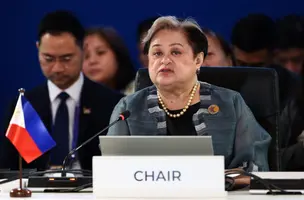
DAVOS, Switzerland –- President Gloria Macapagal-Arroyo on Friday night rallied Asean leaders to make a difference in the region by getting detained opposition leader Aung San Suu Kyi freed in Myanmar.

The President ratcheted up calls for the release of the detained leader in a strongly-worded message she delivered at the Asean session of the World Economic Forum in this Swiss ski resort.

Arroyo said the regional group should attain a “level of democratization” on the issue of human rights “if we are to work collaboratively for the common good.”

“We must see political reform. We must see Aung San Suu Kyi released — and now. Our present Asean knows our position on this,”‘ she told Asean leaders and dignitaries during the high-level session at the Congress Center.

She warned that the Philippine Senate would not ratify the Asean Charter unless the legislators saw “real political reforms” take place in Myanmar, which is also known as Burma.

“The Senate will not ratify the Asean charter if we don’t see real political reforms in Asean,” Arroyo said at a plenary session of the World Economic Forum here on Friday evening (past midnight Saturday in Manila).

“So we must work together to make the tough choices to make Asean real and Aung San Suu Kyi free,” she said in the session, titled “The Emerging Asian Community: Role of Asean.”

Malaysian Prime Minister Abdullah Ahmad Badawi, however, stressed that the 10-member Asean must always abide by its policy of “non-interference.”

“It’s important to respect the principle of non-interference with the internal affairs of member countries. [That's why there's] a problem on how to deal with the Myanmar issue,” he said.

The President delivered the same message when she addressed the Gender Parity Group minutes later, also at the Congress Center.

“What should we do? We stand up and call for Aung San Suu Kyi’s freedom,” she said. Arroyo has consistently advocated that Asean take a more active role in introducing reforms in Myanmar. At the 13th Asean summit in November last year, she called on her fellow Asian leaders to work for the release of Suu Kyi.

Activists believe people power is still strong enough to topple junta

South China Morning Post – 21 January 2008

Four months after the junta in Myanmar crushed the biggest pro-democracy protests in nearly 20 years, activists haven’t given up hope of overturning the regime. In the first of a three part series, Graeme Jenkins explores the challenges facing the underground pro-democracy movement.

Myanmar’s pro-democracy activists are weakened and on the run, but still believe people power can overthrow the military regime.

Detained Nobel Peace Prize laureate Aung San Suu Kyi has met a government negotiator four times since protests were violently crushed in September.

But in an interview this month, the most senior Myanmese democracy leader to escape arrest so far called the UN-backed process a sham.

And he gave rare insights into the obscure world of Myanmar’s underground democracy movement.

The South China Morning Post met him at a secret location and can identify him only by his code name, Phoenix.

He is the acting leader of the “88 Generation” group made up of people who led the demonstrations in 1988, when 3,000 demonstrators were killed by the military.

He claims to be instrumental in orchestrating the latest protests, when thousands of monks took to the streets to demand political change.

“Many people thought I was behind this,” he said.

After earlier demonstrations were disrupted by government thugs, “we thought of getting more power, and that power we can get from the monks. We started talking to the monks to show their support for our movement and to back us up”.

The talks between Ms Suu Kyi and the government were brokered by the UN special envoy Ibrahim Gambari after the junta crushed the protests, killing at least 31 people and arresting hundreds in night-time raids.

“It seems like a trap set by the government to buy some time from the international community,” Phoenix said. “Mr Gambari is trying to come again, but I don’t expect much of what he can do.”

Last Thursday (Jan 17), the UN Security Council upbraided Myanmar for slow progress on reforms since the protests, including dragging its heels on the release of political prisoners and in pursuing a genuine dialogue with opposition leaders. Mr Gambari said he had asked the junta if he could visit this month, but had been told mid-April was better.

Phoenix said he welcomed international pressure on the regime, but cautioned that it was not the solution. “The answer lies within us, within the country. The problem is not that the government is strong, but the opposite – we are not strong enough.”

Yangon is a city gripped by fear. After the crackdown, locals try to avoid a foreigner’s eye. No one wanted to get into a conversation.

There are informers everywhere. Each neighbourhood has a government office with photographs of every resident, and where guests must be registered. “Even inside their families, people cannot talk loud,” Phoenix said.

The first protest by monks took place in the northwestern town of Sittwe at the end of August. Nearby, in a candlelit, windowless room, the Post recently met the leader of the Sittwe monks. Many of his followers have been dispersed by the clampdown and he shifts location on an almost daily basis to avoid arrest.

“I am planning to try again to organise a demo. Wherever I go, I talk to my people,” he said. “Whether it is possible or impossible to beat this government I don’t know, but we must try. We will try very soon.”

Outwardly at least, Phoenix is more optimistic. “We have to take time to prepare for a big show sometime in the future,” he said. “It may be six months or in a year or two.”

“With our movement, when it gets stronger and stronger, even some of the top [government] leaders may co-operate with us. We have some reliable information, some of the top government leaders are not very happy with what the police have done to the monks.”

But in a Yangon tea shop one of the many thousands of ordinary people who marched through the streets in September took a less sanguine view. “Our government are killers,” he said. “The people are afraid again and they won’t protest. They know they can’t make a difference. They know they can pay with their life.”

Asean Won’t Let Burma Troubles Slow Regional Integration

Associated Press – 21 January 2008

The 10-member Association of Southeast Asian Nations (Asean) will not let the actions of its troubled member Burma hamper the group’s regional integration efforts, a senior Singaporean official said on Monday (21 Jan)

“We should not and will not let the Myanmar [Burma] issue slow down the integration of our region,” Second Minister for Foreign Affairs Raymond Lim told the Singapore Parliament.

Lim was responding to Singaporean parliamentarians’ questions on why Asean leaders cancelled a scheduled address by UN Special Envoy Ibrahim Gambari at the bloc’s annual meeting in Singapore in November, after Burma had objected.

Singapore Prime Minister Lee Hsien Loong, the chairman of Asean, had invited Gambari to address the summit about the progress made in his meetings with Burma’s junta. But Burma regarded the issue as a domestic affair, Lim said.

“Myanmar [Burma] wanted to deal with the UN directly, and did not want Asean to play any political role. Once Myanmar [Burma] took this position, Asean could not proceed” as it is a consensus-based organization, Lim said.

“It is obviously unsatisfactory that Myanmar [Burma] sees no role for an organization of which it is a member, and on an issue which affects us all. But this is not a matter of Asean’s credibility,” Lim said.

Lim also ruled out the possibility of expelling Burma from the regional bloc, saying it was in Asean’s interests to keep the country as “a member of the family.”

“I don’t think that expelling Myanmar [Burma] from Asean is the solution,” he said. “We still have channels of communication which hopefully can influence the situation in Myanmar [Burma].”

“Myanmar as a regime is known as a very isolated regime. I don’t think it can get any more isolated than it is and to expel it I don’t think is particularly constructive,” Lim added.

“What happens in Myanmar [Burma] affects the well-being of the rest of Southeast Asia. We do not want to see Myanmar [Burma] descend into chaos or implode.”

UN envoy’s return to Myanmar could spur further progress, says Security Council

UN News Service – Fri 18 Jan 2008

Disappointed with the slow pace of change in Myanmar, the Security Council today said an early return to the country by United Nations special envoy Ibrahim Gambari could help promote progress towards democratization and national reconciliation.

Mr. Gambari, who has a standing invitation to return to Myanmar, had requested to go there this month. However, the Government has said it prefers he visit in mid-April.

In a statement read out to the press by Ambassador Giadalla Ettalhi of Libya, which holds the rotating presidency for January, the 15-member body “regretted the slow rate of progress so far” towards meeting the objectives laid out in a presidential statement issued by the Council last October.

They include steps by the Government for a “genuine dialogue” with detained opposition leader Aung San Suu Kyi and all concerned to achieve an inclusive national reconciliation process, and the release of all political prisoners and remaining detainees.

“Council members underscored the importance of further progress, noting that an early visit to Myanmar by Mr. Gambari could help facilitate this,” the statement added.

Speaking to reporters following the Council’s discussions, Mr. Gambari said that while the date of his return is still under discussion, “in view of [the] many issues left on the table, the earlier a visit occurs the better.”

He said the Myanmar authorities need to move toward tangible progress on the constitution, freedom for all political prisoners, and addressing the root causes of discontent among the population.

Mr. Gambari, who has visited Myanmar twice since the Government used force to crack down on peaceful protesters in the summer of 2007, intends to visit India and China later this month.

He noted that while countries in the region have placed on record their support for the good offices role of the Secretary-General on the issue of Myanmar, “there is still more that everybody can do.”

All those who have a role to play, both inside the country and outside, should be given the chance to do so in the interest of moving toward “a peaceful, prosperous but democratic Myanmar with full respect for the human rights of its people,” he stated.

Security Council meets to discuss lack of progress in Myanmar

Agence France Presse – 17 January 2008

The Security Council on Thursday huddled behind closed doors with UN troubleshooter Ibrahim Gambari to discuss what several diplomats described as “the lack of progress” toward democratic reform in Myanmar.

US Ambassador to the UN Zalmay Khalilzad said that the 15-member body also wanted to discuss reports that Gambari, the UN’s pointman in efforts to foster a dialogue betweeen Myanmar’s ruling junta and the opposition, “has not been allowed this month to come back” to the country.

“We want to hear from him about that and talk about what we can do to incentivize the (military) regime to cooperate,” he told reporters on his way to the meeting.

Gambari has visited Myanmar twice since September when the military junta crushed the biggest pro-democracy protests in nearly 20 years.

At least 15 people were killed and 3,000 arrested in the September violence, which sparked global outrage against the regime with the United States and the European Union tightening sanctions against the country’s top rulers.

Thursday, several UN diplomats decried “the lack of progress” in Myanmar since the council in November pressed the ruling junta to “create conditions for dialogue and reconciliation by relaxing, as a first step, the conditions of detention of (opposition leader) Aung San Suu Kyi and by pursuing the release of political prisoners and detainees.”

“The situation in Myanmar has been deteriorating since late last year,” said a Western diplomat who spoke on condition of anonymity.

“We want to assist Gambari’s mediation and see what we can do” to persuade the military regime to ease restrictions on Aung San Suu Kyi and start a genuine dialogue with the opposition, he added.

Woman wounded in latest bomb blast to hit Myanmar

tur – 13 January 2008

A bomb exploded in a public toilet Sunday at Yangon Railway Station, injuring a woman, in the latest of a spate of blasts reported in military-run Myanmar, security sources said.

Aye Myint, 73, who was taking a shower in the toilet, sustained minor injuries in the biceps and right buttock from the blast and was rushed to Rangon General Hospital (RGH), security sources at the hospital confirmed.

On Friday there were two separate explosions, one in a public toilet at Naypyitaw Railway Station, the military’s new headquarters, and another in Bago Division.

Myanmar’s state-run press on Sunday blamed Friday’s two deadly blasts on saboteurs with backing from a ‘foreign organization’ bent on ‘practicing hegemony over Myanmar.’

The New Light of Myanmar, a government mouthpiece, claimed the two saboteurs who set off Friday’s bombs died trying when detonating their ‘US-made powerful explosives.’

The Naypyitaw bomb killed one woman who was originally described by the state press as an innocent victim.

On the same day another bomb was detonated near a football field in Nyaungbintha Village, Bago Division, killing the man who was suspected of planting the bomb and wounding four people.

State media identified the Bago bomber as an insurgent from the Karen National Union (KNU), an ethnic minority rebel group that has been waging a war against Myanmar’s military for the autonomy of the Karen State since 1948.

A second suspect, Saw Ra Makee, was arrested.

‘According to his confession, the man who was killed in the incident was Saw Di Thaw Mu with the rank of corporal in charge of collecting extortion money of battalion 8, brigade 3 of KNU,’ said The New Light of Myanmar.

‘A major group from abroad that is desirous of practicing hegemony over Myanmar provided terrorist insurgent saboteurs with cash and related equipment with the intention of harming the public, causing panic among the people and undermining peace and stability,’ said the English-language daily.

The paper’s Sunday edition also claimed that an investigation had revealed that Naw Gay Lar, the woman killed in the toilet blast, had died trying to plant the device.

‘It can be assessed that the same major organization masterminded these atrocities, for explosives used in both incidents are the US- made powerful explosives and they are identical,’ the paper said